

Three useful pages—or three pages competing with each other?
A case study, a video watch page and a transcript can give people different ways to explore your expertise. The value comes from what each page helps them do.
One story can earn three pages. It does not automatically need them.
More URLs alone do not mean more visibility. Use a case study to explain and demonstrate, a watch page to show the video, and a transcript to preserve the spoken detail. Give each a useful purpose, connect them clearly, and judge the result across all three.
Our recommendation: use three pages when the material supports three useful experiences. When it does not, combine the watch page and transcript. Do not stretch a thin story into extra pages just to target slightly different phrases.
Give people useful ways into the same expertise
A prospective customer may want a quick visual tour. Another wants to understand a difficult design decision. Someone comparing suppliers may want evidence of a relevant completed project. One well-documented job can serve all three needs.
The three-page approach in our video strategy playbook can support that choice. The potential search benefit is reaching relevant searches the original page would not have captured. The visitor benefit is being able to watch, scan or read the explanation in the format they prefer.
Google recommends dedicated watch pages for individual videos and explicitly permits the same video on another page with supporting information. This supports the case-study-plus-watch-page arrangement; it is not a promise that all three pages will rank. Source: Google’s video SEO guidance.

Understand the risk before trying to solve it
Duplicate or near-duplicate pages
If pages repeat essentially the same content, Google may select one representative URL and leave the alternatives out of search. Ordinary duplication is not automatically a spam violation or a site-wide penalty.
Different words, the same job
Two pages can be written differently yet still answer the same question for the same audience. They may compete for the same searches. Changing “modern” to “contemporary” in a title does not establish a separate purpose.
More work, little added value
Additional pages need maintenance and clear links. If visitors gain nothing from a separate page, producing and maintaining it may add effort without adding useful reach or inquiries.
Search overlap alone is not proof of harm. A guide and a watch page appearing for related queries can be perfectly sensible. The practical concern is whether the extra pages confuse visitors, displace a more suitable page, or fail to add enough value to justify their upkeep.
“SEO dilution” is a loose description, not a formula. Publishing three related pages does not automatically divide the site’s authority into thirds. Diagnose an observed problem before merging or hiding useful content.
Give each page a job before giving it keywords
| Page | Visitor’s need | What belongs here | Avoid |
|---|---|---|---|
| Project case study or guide | “Explain the problem and show me the evidence.” | Context, constraints, decisions, photographs, supported outcomes and useful advice beyond the narration. | Pasting the entire script and calling it a different article. |
| Video watch page | “Let me watch the explanation.” | A prominent player, accurate title, short introduction, chapters and links to supporting material. | Burying the player beneath a long article or duplicating the whole case study. |
| Transcript page | “Let me read or find what was said.” | The faithful spoken account, readable paragraphs, descriptive headings, timestamps and relevant images. | Rewriting the speaker’s words to manufacture keyword differences. |
A guide is not always a case study. A guide explains choices; a genuine case study documents a real project. Use the structure that fits your material and label fictional examples clearly.
Seven safeguards that make the strategy more useful
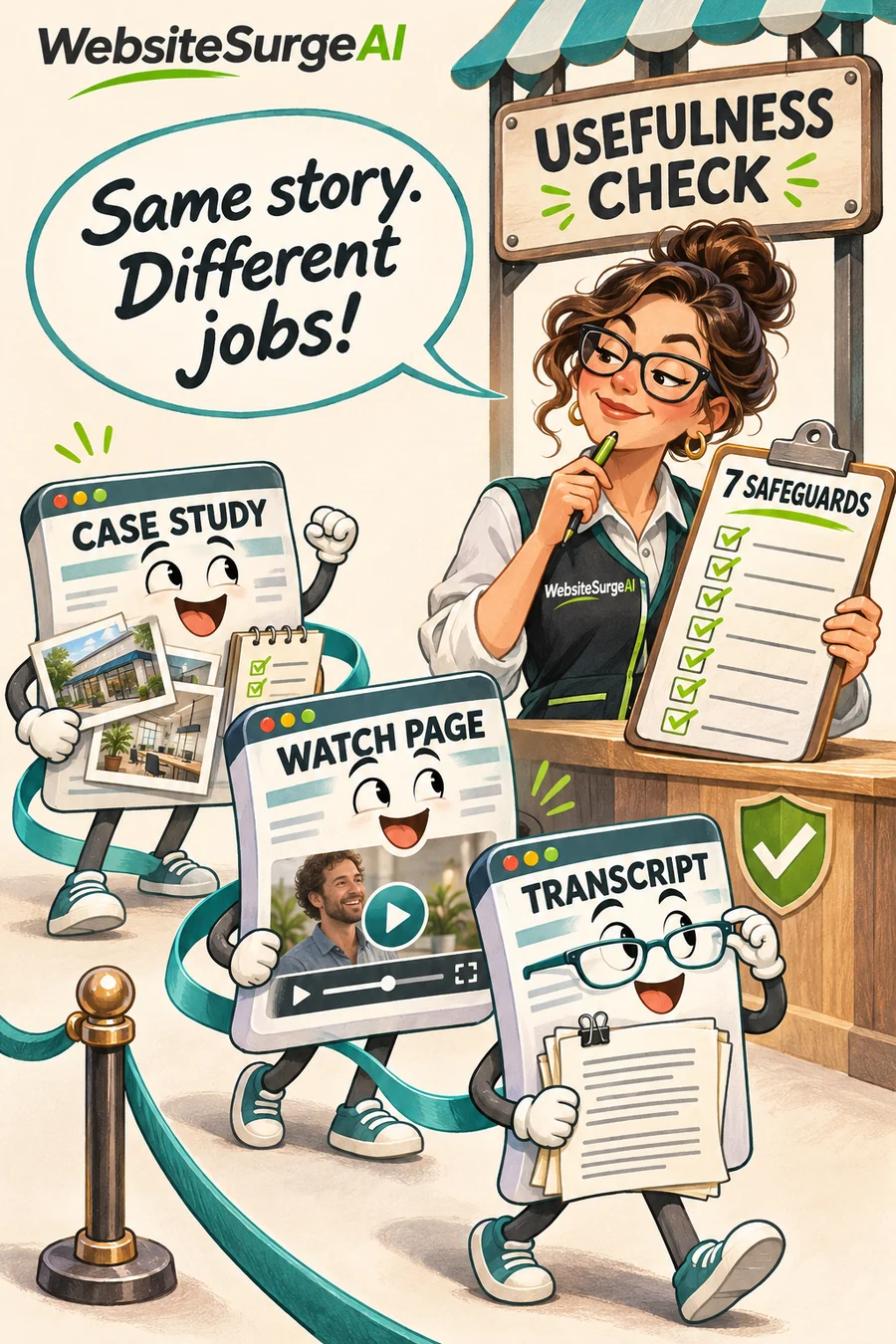
Start with one solid source of information
Collect genuine project photographs, the customer’s requirements, the challenges, your decisions and supported results. A conversation or existing project notes may be enough to begin. Keep client permissions and factual checks part of the process.
Write a one-sentence purpose for each page
If you cannot explain why someone would choose one page over another, revise the plan. “It targets a different keyword” is not enough.
Let the article and video take different approaches
The article can compare options and explain details. The video can follow a concise story or demonstrate one problem. Shared facts are useful; copying the same explanation everywhere usually adds little.
Preserve the transcript’s integrity
Correct transcription errors and add punctuation, headings and timestamps for readability. Keep the meaning and spoken wording faithful. Clearly separate any extra editorial explanation from the transcript itself.
Choose phrases that the content actually supports
Use distinct, descriptive titles and introductions. A transcript mentioning AI narration is not automatically a complete “how to create AI voiceovers” tutorial. Do not broaden locations, outcomes or services merely to capture another search.
Connect the pages as a coherent set
Use descriptive links such as “Read the project story,” “Watch the installation video” and “Read the full transcript.” Link supporting pages to the most relevant guide or service, and include indexable pages in the sitemap. Visitors should understand where they are and what the next page offers.
Keep technical signals consistent
Give genuinely distinct, indexable pages their own canonical URLs. A canonical tag identifies a preferred version of duplicate or very similar content; it is not a general cure for pages sharing a topic. Avoid pointing every supporting page to the article by default.
If two pages really duplicate each other, decide whether to merge them and redirect the retired URL, or retain an alternate version with an appropriate canonical. Do not use
noindexmerely to select a preferred duplicate: it removes a page from search. Google explains the canonical options and limitations.
Sometimes two pages are the better answer
If the video is short and its transcript adds little beyond the article, put the readable transcript below the player on the watch page. Keep the video prominent and the viewing experience clear.
A separate transcript page is more useful when people benefit from its substantial spoken detail, sections, illustrations or timestamp navigation. There is no minimum word count that makes the choice right. The test is whether the page serves a useful reading task.
Use the number of pages the content deserves. A three-page workflow is an option, not a production quota.
See the difference in Sam’s story
We have applied this approach to our own explanation of video marketing without appearing on camera. It uses a broad guide, a short illustrated story and its transcript. Sam is fictional; this is a publishing example, not a client case study or evidence of improved rankings.
The guide
Compares formats, advantages, limitations, trust considerations and the information a business needs to contribute.
Read the camera-optional guide →The watch page
Puts Sam’s 2:42 story first, with a concise introduction and links to specific moments.
Watch Sam’s story →The transcript
Preserves her narrative about camera discomfort, AI skepticism, project photographs and useful explanations.
Read Sam’s full transcript →The guide is not simply the script in article form. Its breadth and structure are different. The watch page offers a viewing experience, while the transcript provides the spoken account in text. Their related subject matter is intentional.
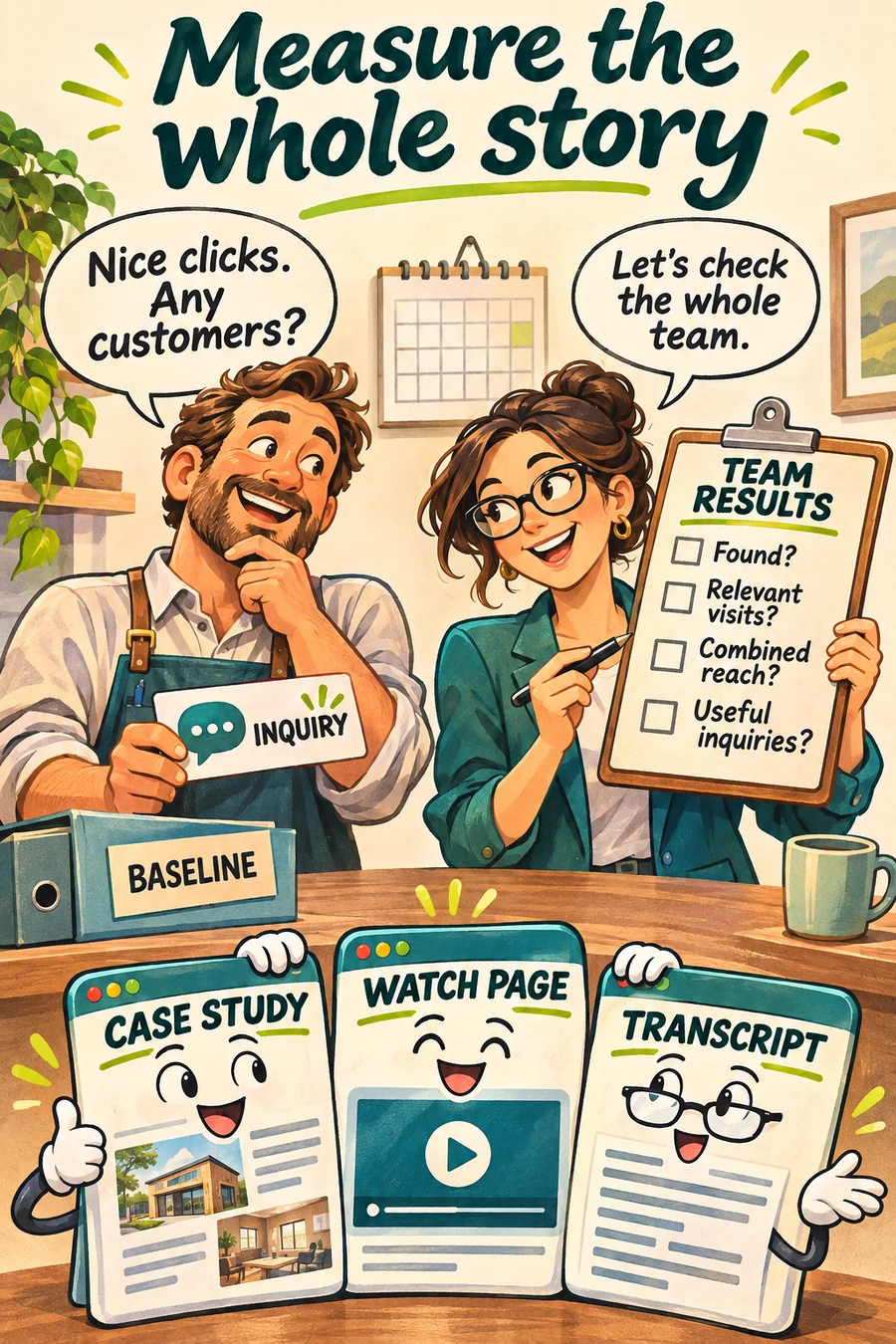
Our assessment is that these are meaningfully different resources. Their incremental search and business benefit still needs to be measured.
Measure the result across the set
Record a baseline before expanding an existing project where possible. Review results once the pages have had time to be discovered and accumulate meaningful data; new pages or small samples do not support confident conclusions.
- Discovery: Are the pages indexed? Which canonical URL has Google selected? Has the watch page’s video been indexed?
- Search fit: Which queries bring each page impressions and clicks? Is the page shown a useful answer to that query?
- Combined reach: Are relevant visits across the set growing? Allow for seasonality, other site changes and traffic that may simply have shifted between pages.
- Business contribution: Do visitors reach the service or contact page, ask better questions, or make qualified inquiries? Compare that contribution with production and maintenance effort.
Google’s video monitoring guidance explains the relevant Search Console reports. Search Console can show search performance; inquiry tracking and customer conversations help establish business value.
What should trigger a change?
If Google groups genuinely different pages as duplicates, inspect the rendered content, canonical tags and internal links. If interchangeable pages compete without adding value, strengthen their distinct purposes or consolidate them. If all three help visitors and attract relevant searches, keep them even if some queries overlap.
A transcript receiving little search traffic may still be valuable for accessibility and existing visitors. Decide its place using both purposes, rather than treating rankings as its only justification.
Before you publish, ask five questions
Need help creating and connecting project, video and transcript pages? Our monthly services and pricing explain how this work fits your SEO priorities and budget.
A clear purpose
Can we explain the distinct job of every page?
More than the script
Does the case study or guide add useful material beyond the script?
A useful viewing experience
Is the video easy to find and watch, with a faithful transcript available?
Accurate signals
Do titles, links, locations and claims accurately match the content?
A way to measure value
Do we have a practical way to assess the combined result?