

AI voiceover for project videos: Sam’s story
How project photographs, human expertise and a narrated explanation can work together. Read the complete script from “Hate Being on Camera? Your Business Can Still Use Video.”
Watch Sam’s story →The full narration from our finished video, with section headings added for reading. Timestamps open the corresponding moment on the watch page. Sam and her projects are fictional illustrations; this is not a client testimonial.
0:00 Sam knows her work, but hates being filmed
Sam was proud of her work.
Point to something she’d built, and she could tell you why she’d designed it that way. What the customer needed. The awkward problem nobody noticed. The detail that made everything come together.
But point a camera at her?
Suddenly, explaining her own name became surprisingly difficult.
She understood why video could help. Customers could see her work, understand her thinking, and get a better sense of what they were paying for.
She just didn’t want to be the presenter.
So we suggested another approach.
“What if we show your work—and use AI to help tell the story?”
0:34 Why Sam is skeptical of AI videos
Sam looked unconvinced.
“You mean those dreadful videos with the fake people and the voices that sound almost human?”
She’d seen plenty. Perfect smiles. Strange hands. Confident voices saying absolutely nothing.
She had no intention of making her business look like that.
Fair enough.
But there was another possibility.
0:52 Project photographs and expertise come first

Start with photographs of a project she’d actually completed. Ask her what the customer wanted, what made the job difficult, and why she’d chosen that particular solution.
Then build the video around her answers.
Her photographs. Her decisions. Her expertise.
An AI voice could explain the story while viewers saw the work. Illustrations could help explain a difficult idea, clearly distinguished from photographs of the actual project.
Sam wouldn’t need to appear on camera at all.
1:22 Will the explanation help a customer?
“But wouldn’t people know it was AI?”
Some would. And some might dislike it.
But would the explanation help a potential customer understand what she’d done—and why it mattered?
That was worth finding out.
An AI narrator wouldn’t make her craftsmanship any less real. And filming herself wouldn’t automatically make a weak explanation useful.
The content still had to earn the viewer’s attention.
It needed to answer a question, demonstrate something worthwhile, or help someone decide whether to get in touch.
1:51 The details only the business owner can supply
And Sam still had an essential part to play.
We needed the details. The photographs. The thinking behind the finished result.
AI couldn’t invent that experience for her.
What it could do was help her share it.
2:04 Voiceover and other ways to present the work
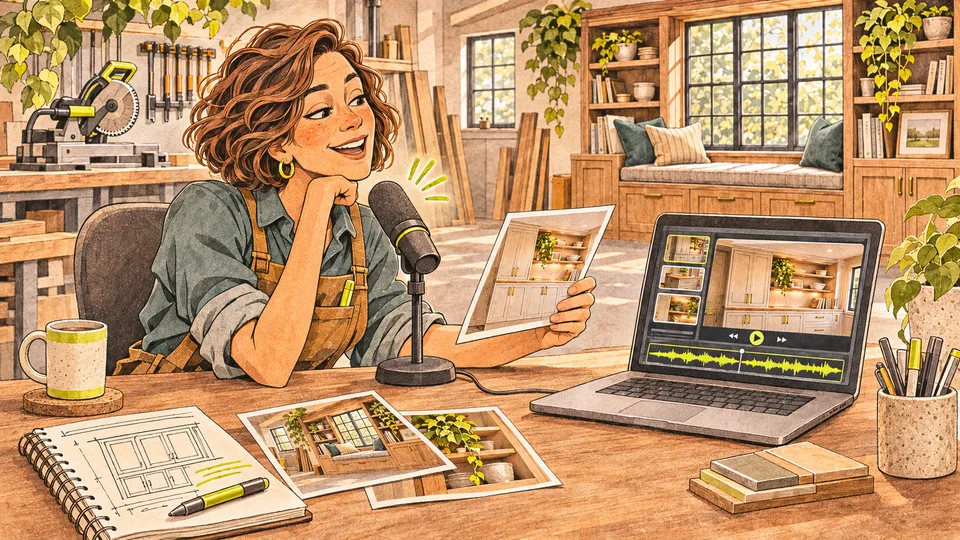
She had choices, too.
Her own voice over project images. AI narration. A colleague presenting. Perhaps, eventually, a short clip of Sam explaining one detail on site.
She didn’t have to commit to one format forever.
She could start with one project, try an approach, and judge the response.
Her discomfort in front of a camera didn’t have to decide whether customers got to see what she could do.
2:26 Creating video as part of SEO work
If you’re in Sam’s position, start with a conversation.
Where video fits your SEO strategy, we can help create it as part of that work, with no separate video production charge.
Bring your knowledge. Bring examples of your work.
Let’s find a way to show people why it matters.