
First, get found.
Then, give people reasons to choose you.
Trust signals have two jobs: supporting your visibility in search and AI answers, and helping customers choose you once they find you. A convincing website has limited value if the right people never see it.
AI makes polished claims easier to produce. Real expertise, documented work and independent recognition give your business something more useful: evidence. Make that evidence visible to both prospective customers and the systems they use to find businesses.
If you don’t show up, you may never get the chance to earn the customer’s trust. Build evidence that helps you get discovered—and makes choosing you easier.
Get found
Give search engines and AI systems relevant, credible evidence to discover and use when answering a potential customer’s question.
Get chosen
Give the person who finds you concrete reasons to believe your claims, contact your team and choose your business.
Trust signals affect whether you get found in the first place
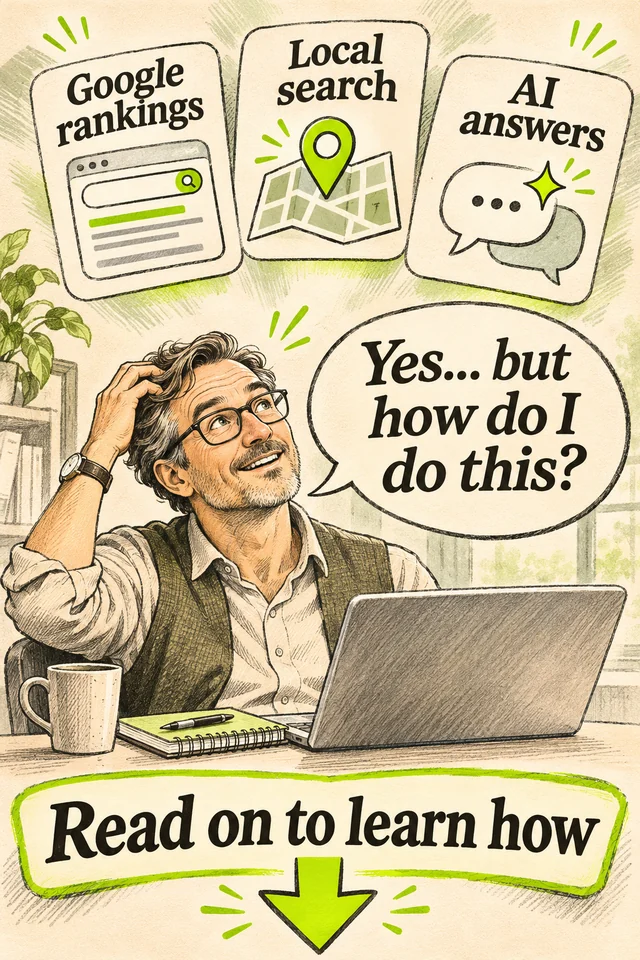
If your business never appears in a relevant search or AI-generated answer, prospective customers may never reach the evidence on your website. Building trust belongs in your SEO strategy as well as your sales strategy. The aim is to make your expertise discoverable, understandable and supported by evidence.
Google rankings: relevance needs credible support
A page must answer the searcher’s question. Evidence of real experience, useful detail and reliable sourcing strengthens that answer. Google’s guidance encourages content that demonstrates expertise and makes its authorship clear; E-E-A-T describes these qualities, rather than a single score you can increase by adding badges. [2]
There are also established ranking mechanisms: Google uses link analysis, including PageRank, to understand pages and their usefulness. Relevant editorial links earned from other websites can therefore do more than reassure visitors. A self-published credential or LinkedIn profile is not equivalent to an independent editorial endorsement. [5]
Local search: reputation can influence visibility
For local businesses, Google says results depend mainly on relevance, distance and prominence. Complete business information helps it match a business to a search; links, review volume and positive ratings can contribute to prominence and local rankings. These are local-search considerations, not a promise that adding testimonials to your website will raise every organic page ranking. [4]
AI answers: give the system useful evidence to find and cite
Google’s AI search features can explore related questions and link to supporting pages. To be eligible as a supporting link, a page must be indexed and eligible for a search snippet. Clear, accessible project evidence gives those systems material to retrieve; eligibility does not guarantee selection. [1]
Our practical recommendation is to connect your service pages, real project stories, named specialists and independent sources. That creates useful routes for people and search systems to follow. AI providers differ, so there is no universal formula for becoming a recommended business—and being cited as a source is not necessarily an endorsement.
Publish evidence where it answers a real search question. Make it crawlable, link it from relevant pages and support it with genuine outside recognition. Trust signals work alongside technical SEO, relevance and competition; they do not replace them.
What does “building trust” actually mean?
It means reducing the uncertainty someone feels before choosing you. A prospective customer may like your work and still be wondering:
- Are these real people running a real business?
- Have they successfully handled something like my project?
- Do they understand the problems I might face?
- Will they explain the costs, limitations and tradeoffs honestly?
- What happens if something goes wrong?
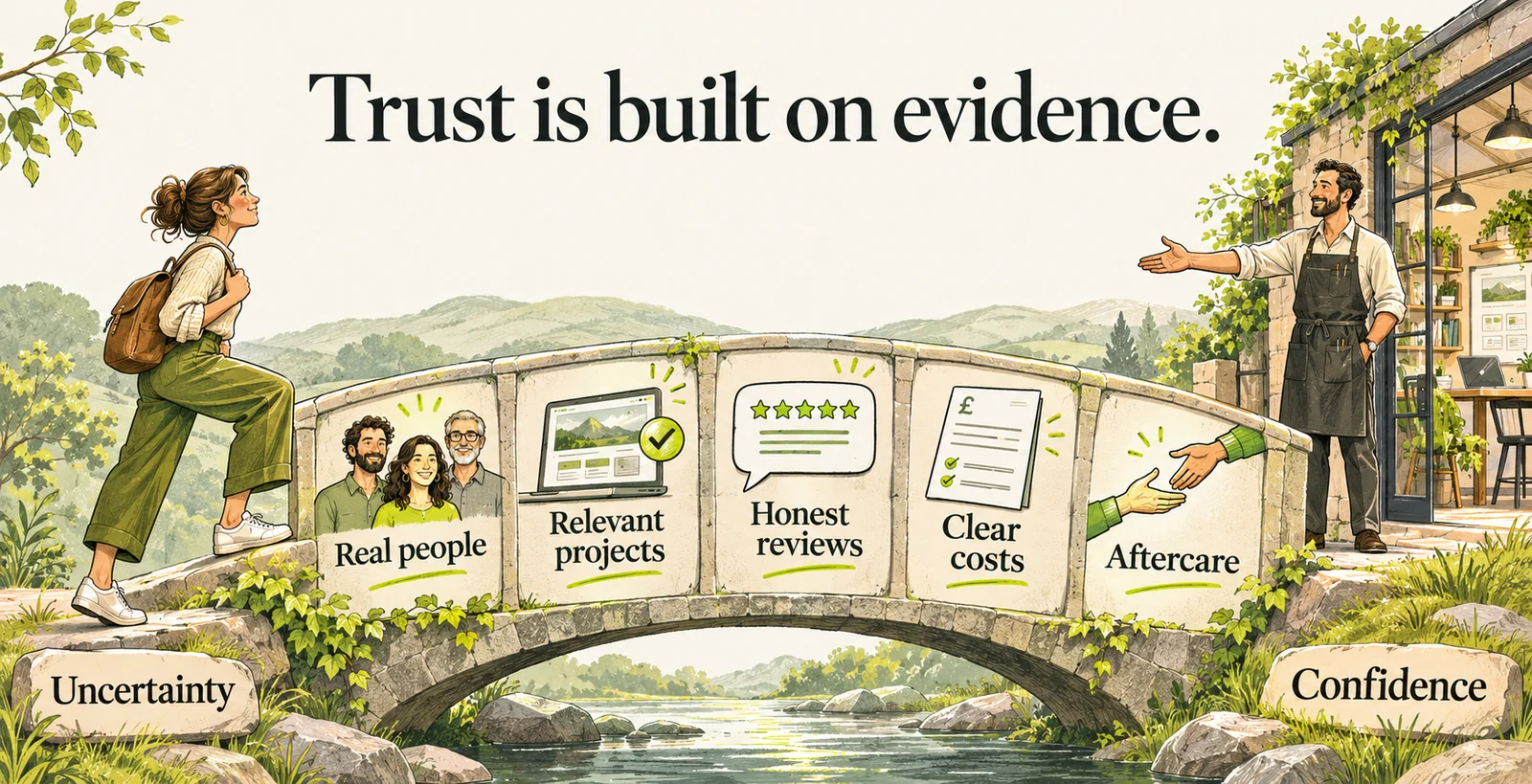
A trust signal is a piece of information or evidence that helps someone answer one of those questions. A named expert, a detailed project story, an independently published review or a clear explanation of your process can each serve that purpose.
Trust is also specific to the decision. A beautiful portfolio can demonstrate design ability. It cannot, by itself, establish that a company meets deadlines or provides good aftercare. Different claims need different evidence.
Why this matters more in the age of AI
Sounding knowledgeable is easier. Demonstrating knowledge takes evidence.
AI can help almost any business write fluent explanations and confident marketing copy. That is useful—but it makes polished wording a less distinctive reason to choose one company over another. “Excellent service” and “unmatched expertise” tell a visitor very little unless the website shows what those claims mean in practice.
A documented project, an explanation of a difficult decision and an independent customer account give people something more substantial to evaluate. AI can help you organize this material. It should not invent the underlying experience.
Search can investigate a more detailed question
Google says its AI search features may run multiple related searches across subtopics and data sources to construct an answer. A detailed comparison can therefore involve more than finding a page that matches one phrase. Its guidance also says established SEO practices still apply; there is no special set of AI-only eligibility requirements. [1]
A short search might be “wine cellar installer Miami.” A more detailed question might be “Who has experience building glass wine cellars in humid coastal homes, and how do they prevent condensation?”
A project page explaining the conditions, design choices and result can help answer the second question. A homepage that simply repeats “Miami’s leading wine cellar experts” offers much less useful evidence. This is an illustrative example, not a prediction of which company an AI system will recommend.
This builds on Google’s existing focus on trust
Google already describes experience, expertise, authoritativeness and trustworthiness—often shortened to E-E-A-T—as qualities its systems seek to recognize. It identifies trust as the most important of these, while explaining that E-E-A-T is not a single ranking factor. [2]
We should not claim that every AI system assesses trust more accurately or deeply than traditional search. Systems vary, their methods are only partly public, and AI can misunderstand or repeat poor information. What has changed is the opportunity for evidence to inform a synthesized answer as well as a visitor’s decision.
The practical response is to make your business easier to understand and your claims easier to verify. That helps people regardless of how they find you.
Nine types of trust signals worth building
Each signal below has a customer role and a potential search role. Some connect to documented ranking mechanisms; others make your content more useful or your business easier to verify. These are practical categories, not nine algorithm scores.
| Trust signal | The question it answers | What to show | SEO and AI visibility role |
|---|---|---|---|
| 1. Identity and accountability | Who am I dealing with? | Real team members, relevant biographies, business ownership, genuine service locations and a working contact route. Name the person responsible for specialist advice. | Identify who is responsible for the content and why they know the subject. Consistent team and LinkedIn profiles support verification; a profile link alone is not a ranking boost. |
| 2. Firsthand experience | Have you actually done this? | Original project photos, demonstrations, job records and case studies describing the problem, constraints, work and outcome. Use dates and locations where appropriate and permitted. | Answer specific service and project questions with original detail. This gives search and AI systems useful information beyond generic marketing copy. |
| 3. Expertise and judgment | Do you understand the decisions? | Useful explanations of why one approach was chosen over another, common mistakes, limitations and relevant qualifications. Link to verifiable credentials where available. | Make specialist answers substantive, accurate and attributable. Qualifications support credibility; simply listing them does not guarantee higher rankings. |
| 4. Customer experience | What was it like to hire you? | Genuine reviews and attributed testimonials, preferably with a route to the original source. Specific accounts of communication, installation and aftercare are more informative than unexplained star graphics. | Google reviews and positive ratings can help local rankings [4]. On-site testimonials primarily provide customer evidence, not an automatic organic ranking lift. |
| 5. Independent recognition | Does anyone else support your claims? | Relevant trade coverage, authentic association listings, manufacturer relationships and documented awards. Explain the relationship and link to the issuing organization when possible. | Genuine editorial links can contribute through Google’s link-analysis systems [5]. An award logo without context or verification is a weaker claim. |
| 6. Transparent process and terms | What am I committing to? | How work starts, what affects cost, what is included, likely dependencies, responsibilities and applicable warranty or cancellation terms. Be clear about estimates and exclusions. | Answer cost and process questions people actually search for. Clear terms chiefly support customer decisions; they are not a disclosed standalone ranking factor. |
| 7. Evidence behind results | Can I check the outcome? | Measurements, properly explained before-and-after comparisons, methods and sources. Say what was measured and when; separate an observed improvement from an unproven claim about its cause. | Provide original findings that other sources can reference. Explain methods and limits so the information is useful and checkable. |
| 8. Consistency and currency | Does the story hold together? | Accurate business details across your site and relevant listings, current credentials, working links and corrected advice. Update content when facts change, not merely to display a newer date. | Keep business information accurate for local matching [4]. Correct stale facts and contradictions; changing a date alone does not establish value. |
| 9. Care in the customer experience | Will you handle my inquiry responsibly? | A usable, accessible website, secure connections, clear privacy information, sensible forms and reliable follow-through. These support confidence; a padlock alone does not prove a business is honest. | Keep useful evidence accessible to visitors and crawlers. Good usability supports the journey; polished design alone does not establish authority. |
One item can do several jobs. A project video featuring the actual installer can demonstrate identity, firsthand experience and judgment at the same time. Its strength comes from what it reveals, not simply from being a video.
The strongest evidence connects
Imagine a case study that names the project, shows the work in progress and explains a challenging decision. A team biography identifies the person responsible. An independent review describes the customer’s experience of that same work.
These pieces reinforce each other because they tell a consistent, checkable story. Repeating your own claim on several pages does not provide the same independent support.
Put evidence where the question arises. Show a relevant project beside a service description. Explain qualifications beside specialist advice. Put process and next-step information near the inquiry form. Don’t make visitors hunt through an isolated testimonials page for every reason to believe you.
Turn a claim into something useful
The following examples are hypothetical, not claims about a particular business.

“We are experts in custom wine cellars.”
The visitor must take your word for it.
“Here is how we approached this coastal installation.”
Show the real space, explain the temperature and humidity requirements, describe the enclosure and cooling decisions, and document what was checked at completion. Include actual results only when records support them.
You can do the same in almost any industry. A kitchen designer can explain a layout compromise. A logistics business can document how it handled an awkward delivery. A bookkeeper can explain a reconciliation problem using an anonymized example with permission.
The strongest material is often already inside the business: the work your team does and the reasons they do it that way.
Video can make expertise easier to judge
A person explaining a real decision can reveal understanding that a generic paragraph cannot. Let the specialist show the detail, explain the alternative and describe why it mattered.
Support the video with a readable summary or transcript, relevant project facts and links to supporting material. Microsoft’s publisher guidance recommends clear structure and evidence such as examples, data and sources to make content more useful in AI-generated answers. [3]
Video itself is not proof. AI can generate convincing people and scenes, too. Use real project footage when presenting real work, and clearly label illustrations, reconstructions or synthetic presenters so viewers are not misled.
Explore our trust-building video strategy for a practical way to turn everyday expertise into useful content.
What weakens trust?
- Unsupported superlatives: “the best,” “number one” or “guaranteed” without a clear basis.
- Manufactured proof: invented reviews, fictional case studies, false credentials or stock images presented as completed work.
- Missing context: impressive numbers with no timeframe, method or explanation of what they measure.
- Contradictions: different business identities, outdated qualifications or incompatible promises across pages.
- Concealed tradeoffs: omitting material costs, limitations or conditions until after someone makes contact.
Clear formatting and structured data can help communicate information. They cannot turn an unsupported claim into evidence. Publish what you can stand behind.
Start with the question that makes customers hesitate
- Choose one important service. What must someone believe before they feel comfortable buying it?
- List the doubts. Ask the people who handle inquiries which questions keep coming up.
- Find the evidence. Gather a relevant project, a knowledgeable team member and a genuine customer account where available.
- Build one useful page. Explain the problem, show the work, describe the decisions and make the next step clear.
- Check it regularly. Keep details accurate and remove claims the business can no longer support.
Measure both stages: relevant search impressions and clicks, visibility for priority services, observable AI citations and referral visits, then qualified inquiries and sales. Track changes over time; one ranking movement or AI mention does not establish what caused it.
Make your expertise easier to find—and easier to believe.
Start with one real project that answers an important search question. Connect it to the relevant service and specialist, then show the evidence behind the result.
Explore trust-building video strategies →Sources and editorial notes
This article combines official search-provider guidance with WebsiteSurgeAI’s practical editorial framework. The nine categories and hypothetical business examples are our organizing approach, not disclosed algorithm weights.
- Google Search Central: AI features and your website — multi-query exploration and continuing SEO fundamentals.
- Google Search Central: Creating helpful, reliable, people-first content — experience, expertise, authority and trust.
- Microsoft Bing: Introducing AI Performance — clear content structure and supporting evidence.
- Google Business Profile: Tips to improve your local ranking
- Google Search Central: A guide to Google Search ranking systems
Published November 5, 2026. AI-assisted editorial content from WebsiteSurgeAI, a Holistic Web Presence resource. Provider guidance can change. This article does not promise search visibility or assert a universal AI trust score.