
Video marketing without being on camera
Your knowledge is valuable. Your willingness to stand in front of a lens is optional. Explore the ways to make useful videos, what you gain, and what you give up.
Start with a conversation, your notes, or a useful page you already have. We can help turn it into video.
“I know I should make videos. I just don’t want to be in them.”
For many business owners, that is where the conversation ends. They imagine lights, a camera, a script to memorize, and twenty attempts to sound like themselves.
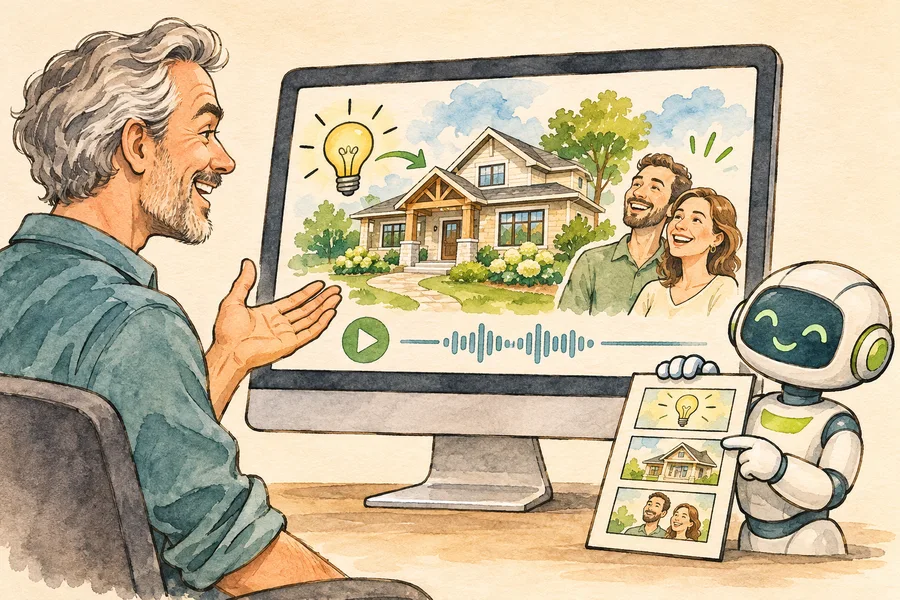
But appearing on camera is only one way to communicate. Your ideas, experience, and judgment can be yours while AI helps turn them into narration, illustrations, and a finished video.
You don’t have to become a performer to have something worth saying. The starting point is still a useful video strategy built around your customers’ questions.
Keep the expertise. Choose how to present it.
You supply the insight
Your experience, answers, examples, and perspective give the content its substance.
We choose the format
Narration, illustrations, real project footage, a demonstration, or a thoughtful mixture.
You check the truth
The finished message must accurately reflect your business and what you can deliver.
AI can help with production. It does not remove the need for judgment, accuracy, or a reason for the viewer to care.
The irony? We’re already showing you another way.
On this website, Tim has created a video using AI narration and matching AI-generated images. It communicates his thinking without requiring him to deliver the presentation in front of a camera.
That is the approach we intend to use for a series of illustrated videos here: human ideas and direction, supported by AI production.
The Secret to Great Business Videos
Watch the existing example and judge the explanation for yourself. Does it hold your attention? Does it make the idea clearer?
Watch the illustrated video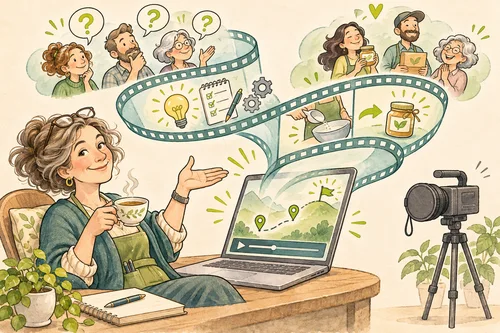
This demonstrates a production method. It is not, by itself, evidence of more leads or higher rankings. Those are separate outcomes to assess.
Six ways to make a video. Only one requires you on camera.
The best choice depends on what the viewer needs to understand or believe. You can use different formats for different subjects.
| Approach | What it offers | The tradeoff |
|---|---|---|
| You speaking on camera | Your face, voice, manner, and personal presence. | Requires recording, preparation, and a willingness to appear. |
| Your voice with visuals | Your personality, supported by photographs, illustrations, or demonstrations. | You still need to record clear audio, although you do not need to be seen. |
| AI narration with illustrations | A repeatable way to explain ideas and tell stories without recording yourself. | Weak scripts, generic imagery, or flat narration can make it feel impersonal. |
| Screen recordings or real project footage | A direct view of the process, product, or work, with human or AI narration. | You need accurate, useful source material and permission to share it. |
| An AI presenter | A visible presenter without filming yourself; an authorized digital likeness is another option. | Some viewers find synthetic presenters distracting. Avoid creating a misleading impression about who is speaking. |
| A mixture of formats | Real evidence where it matters and illustration where it helps explain. | Needs careful editing so the result feels coherent. |
What has changed is the range of practical choices.
Videos made from pictures and narration are not new. What AI adds is help creating the ingredients: developing a script, generating matching illustrations, producing narration, and creating short moving scenes or a synthetic presenter.
You can start with a conversation, notes, an existing article, or a set of project photographs. The job becomes deciding what to say, selecting useful visuals, and checking the result.
For current examples, HeyGen describes text-to-video tools with narration and avatars, while Adobe Express supports generating video from text prompts and starting images. These are examples of capabilities, not a requirement to buy either tool.
Capabilities checked November 6, 2026. Availability and features change. We choose the method to suit the content rather than building the strategy around a particular tool.
What you gain. What you still have to work at.
A lower barrier to getting useful ideas out
- No camera performance is needed for narrated illustration.
- Script changes may be handled without arranging another filming session.
- Illustrations can make abstract ideas easier to explain.
- A consistent visual style can connect a series of videos.
- Existing good content can be adapted into another useful format.
Production still needs care
- AI may mispronounce names, distort details, or invent misleading imagery.
- A synthetic voice can lose some of your warmth and personality.
- Generic scripts and repetitive pictures can feel interchangeable.
- Some people will reject AI-assisted content.
- Reviewing, editing, and making the content genuinely useful still takes time.
“I don’t like AI videos.” Fine. But does your customer find them useful?
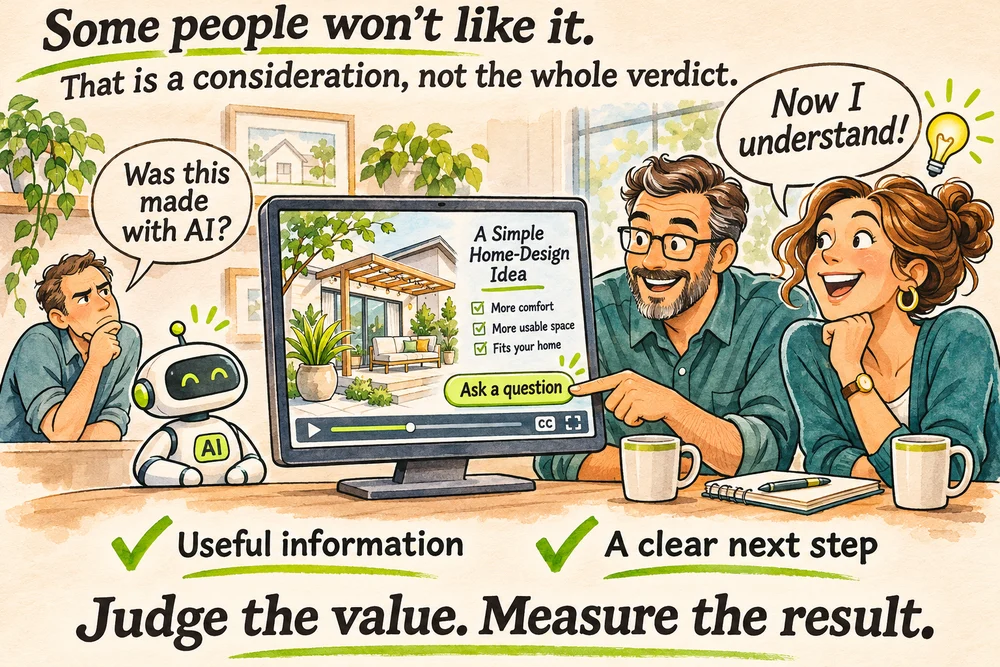
Some viewers prefer a real person speaking to them. Others may care more about whether the explanation answers their question. We should not assume either response represents everyone.
Dislike of AI does not automatically establish that a video is ineffective. Equally, making a video easily does not establish that it works.
The useful test is whether the right audience understands it, finds it credible, and takes a relevant next step. Review viewing behavior, useful inquiries, and customer feedback where you have them. A view count alone cannot tell you whether the content helped win business.
If you have already tried videos without success, start with what would need to change this time. A new production method cannot fix an unclear message or the wrong audience on its own.
Illustration can explain your expertise. It cannot prove your work.
An AI illustration can help explain why condensation develops on glass, how a process works, or what a customer should consider. It cannot establish that your company completed a particular installation.
Use illustration to explain. Use genuine evidence to substantiate.
- Show real projects when claiming real experience.
- Use genuine customer feedback, with permission.
- Label illustrative scenarios so they are not mistaken for client results.
- Do not present a synthetic presenter as a real customer or employee.
- Use a person’s voice or likeness only with authorization.
- Review every factual claim before publication.
Authentic thinking does not require every picture or spoken word to be recorded personally. It does require honesty about what the viewer is seeing. That is part of building trustworthy content.
“What would you need from me?” Usually, less preparation than you think.
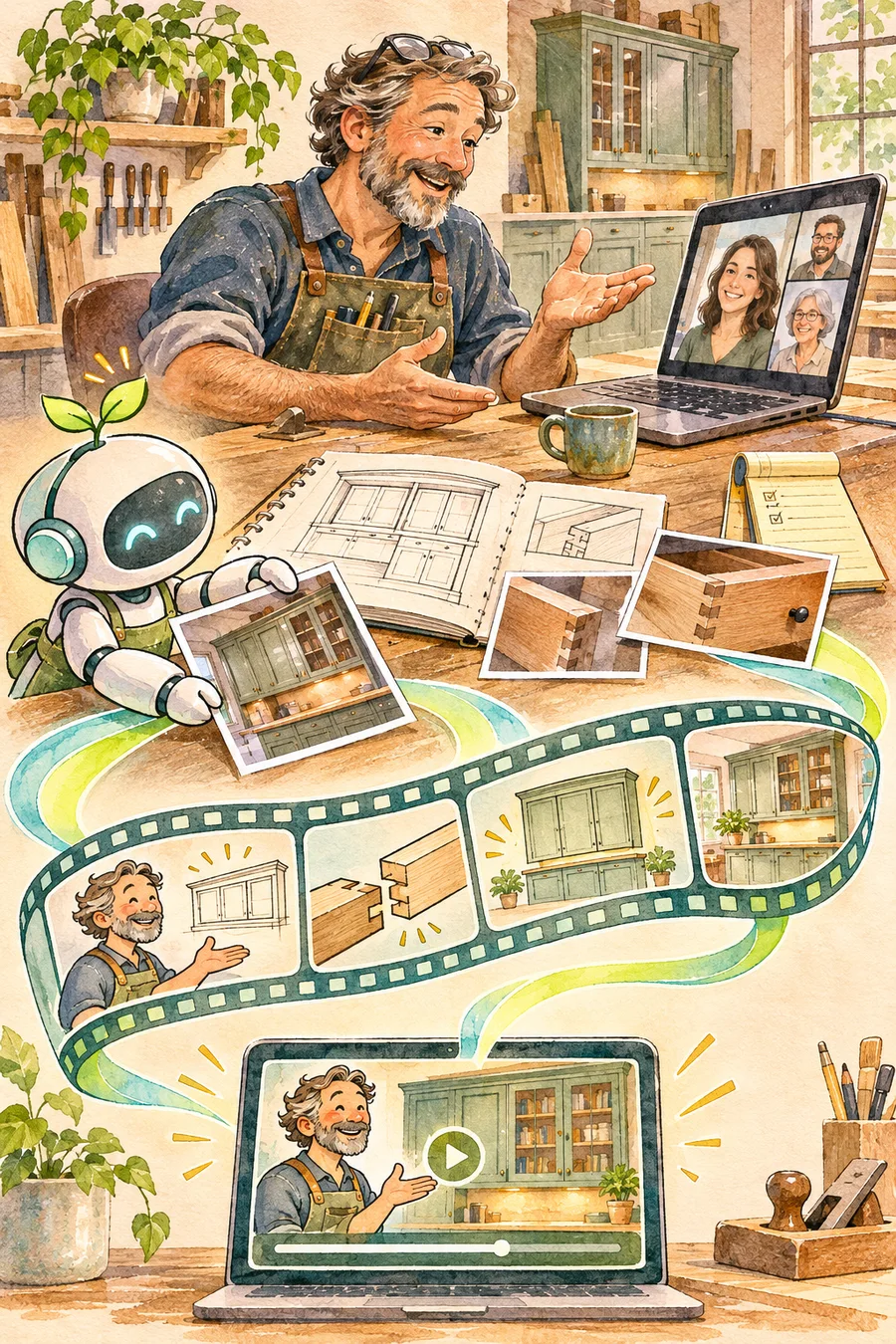
You already explain your work to customers. We can start there.
Tell us about it on a call.
What do customers ask? What do they misunderstand? What makes your approach different? A conference call can give us the material for a useful explanation. It does not need to become the footage in the finished video.
Send the material you have.
Notes, brochures, presentations, project photographs, or a voice memo can provide a starting point. Share only material you are authorized to use, with customer details handled appropriately.
Start with an existing page.
If your website already explains the subject well, we can adapt that content for video. We check that it is current, choose the point worth making, and write for listening rather than simply reading the page aloud.
Review the result.
We develop the content and visuals. You check that the facts, examples, and explanation accurately reflect your business. You do not need to master the production software.
The raw material is your expertise. It does not have to arrive as a finished script.
You may not need to become a video creator at all. That can be part of our job.
You have options. We can work with you across a range of ways to turn your knowledge and your work into useful videos.
If you’ve built something for a customer, being there and showing what you’ve done can be the best approach. Walking through the finished project and explaining your decisions can give people a direct sense of your expertise.
But you have alternatives. Your voice can play in the background while photographs or footage of your work are shown. An AI-generated voice can provide the narration instead, or an AI presenter can introduce the story. We can also combine real project images, illustrated explanations, and short clips of you speaking.
Appearing on camera is a choice. The substance has to come from you. When we’re telling the story of your work, we need the details behind it and genuine images or footage showing what you did: what the customer wanted, what challenges you faced, how you approached them, and what you delivered. AI can help explain that work; it cannot replace the evidence.
You don’t have to package all of that into a finished script. Talk us through it on a conference call, send photographs with a few notes, record a voice memo, or point us to an existing project page. We can help shape the story, choose the format, and produce the video, with you checking that it accurately represents your business.
When video is appropriate for your SEO strategy, we create it as part of our SEO service, with no separate video production charge. We agree the priorities and work with you to find a practical approach that suits the subject, your customers, and how you prefer to contribute.
You’re paying us to do the SEO work. Where video helps that work, it’s part of the service. The aim is useful content that supports your business goals; a video on its own is not a guarantee of higher rankings or more inquiries.
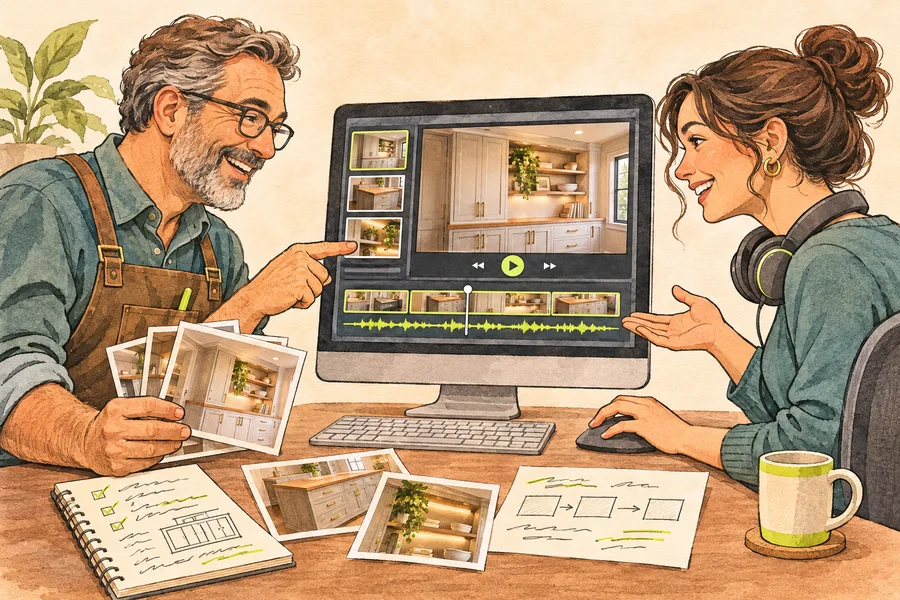
Let’s find the approach that works for you.
Let’s talk about your SEOCamera confidence is optional. Something worth saying is not.
You may eventually choose to appear in a video. You may decide that illustrated narration suits you and your audience better. You may use a mixture.
The important thing is that discomfort in front of a camera no longer has to end the conversation. Start with a useful customer question, your best answer, and a format that does the explanation justice.