
“I tried video and got nothing. What would be different this time?”
You deserve more than another promise about the power of video. You deserve a clear explanation of what would change, why it matters, and how we would judge the result.
You paid for videos. You posted them. Perhaps people watched them.
But the phone didn’t ring. The inquiries didn’t arrive. Eventually, you stopped.
Now somebody is suggesting video again.
“Why would I spend more money doing something that already failed?”
Fair question. You deserve a better answer than “video is important” or “you just need to keep posting.”
If we cannot explain what would be different this time—and why that difference matters—you have no good reason to try again.
A different purpose. A different plan. Something we can measure.
A video is a piece of content. It becomes useful when it does a specific job for your business.
Answer the hesitation
Explain a service, address an objection, or answer a question that is stopping someone from inquiring.
Make the case
Show evidence that you can deliver what you promise and help a customer understand why to choose you.
Support the next step
Help the right person move toward a useful conversation with your business.
The starting point is not “How many videos can we make?” It is “What needs to happen for more of the right people to become customers?” Then we decide whether video can help.
“We made some videos” describes an activity—not a strategy.
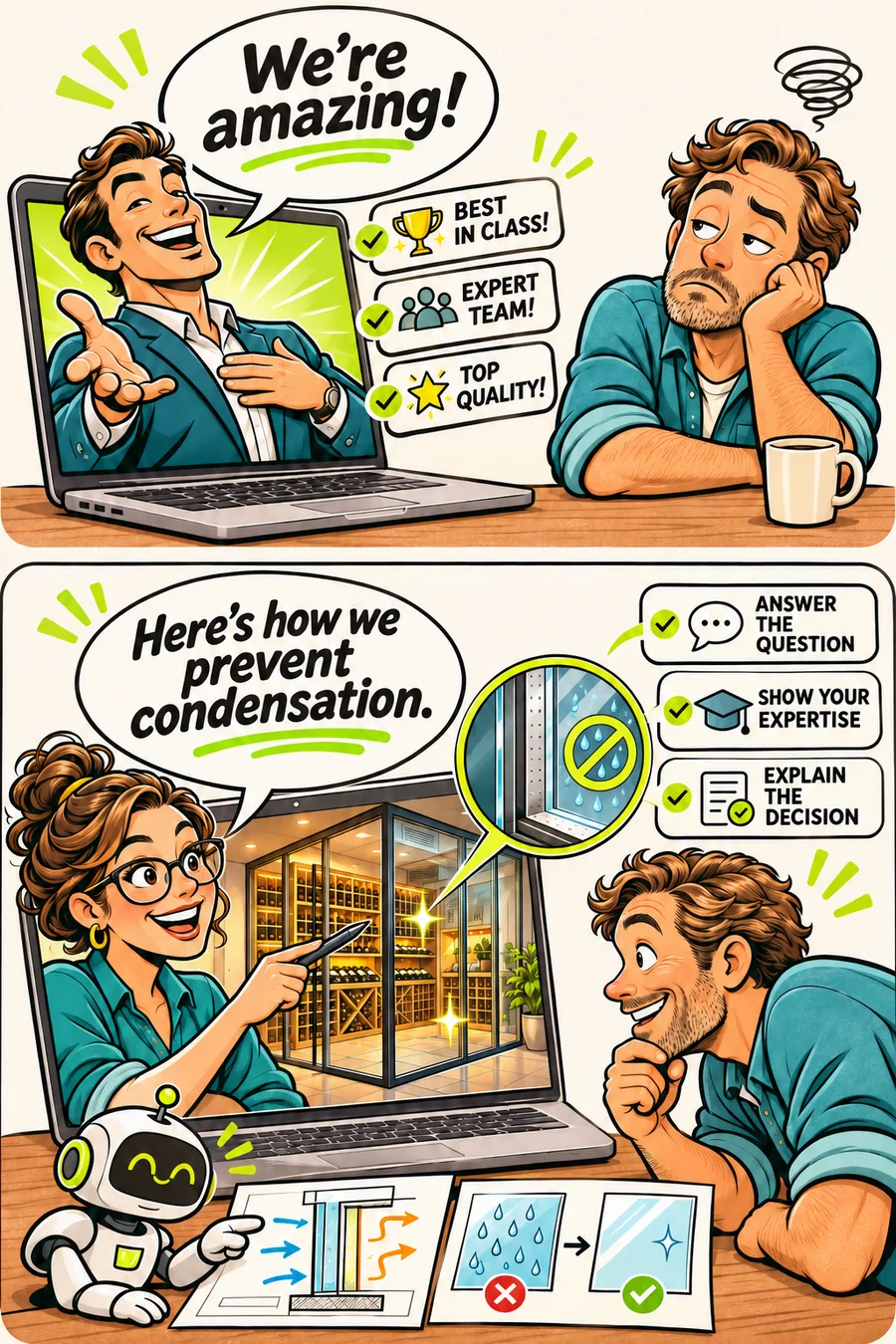
Imagine you sell custom wine cellars.
One video says:
“We create beautiful wine cellars with exceptional craftsmanship. Contact us today.”
Another answers:
“Can you put a refrigerated wine cellar behind glass in a warm, humid home—and what stops condensation forming?”
The second video gives a prospective customer something specific: an answer to a concern that could stop the project going ahead.
It also gives you an opportunity to demonstrate expertise. Show an installation. Explain the design decisions. Describe what can go wrong and how you address it.
That does not guarantee an inquiry. But it gives the video a clear purpose and a useful place on your website.
A polished video saying very little is still saying very little.
This is the foundation of our trust-building video strategy: use real knowledge and real work to help customers make a decision.
Before trying again, work out what happened last time.
“I got nothing” can describe several different problems. They need different responses.
| What happened? | What we would investigate |
|---|---|
| Almost nobody watched | Where were the videos placed, and how were relevant people expected to find them? |
| People watched but quickly left | Did the opening address something they cared about? Did the content deliver on it? |
| People watched but did not inquire | Was the audience relevant? Was there a convincing offer and an obvious next step? |
| The videos attracted the wrong inquiries | Did the topic and message make clear who the service was for? |
| No way to connect videos with inquiries | What tracking was in place, and what could it actually tell us? |
| The videos felt generic or unconvincing | Did they contain your expertise, real examples, and evidence—or just marketing claims? |
Sometimes the videos themselves are the problem. Sometimes distribution is the problem. Sometimes the website loses the visitor after the video has done its job.
What would actually be different this time?
Start with questions your customers already ask.
Your inquiries, consultations, and sales conversations are a starting point. What do customers misunderstand? What makes them hesitate? What do they need to know before they can make a sensible decision?
- “Why does your service cost more than that other option?”
- “How long will this take?”
- “What could go wrong?”
- “Is this suitable for my situation?”
- “What happens after I contact you?”
These questions give the content a business purpose before we start writing a script.
Put your knowledge and evidence into the answer.
Your customers can find generic advice almost anywhere. What they cannot get from a generic script is your explanation of a particular project, the mistake you helped someone avoid, or the trade-off you would recommend based on experience.
AI can help turn that knowledge into clear content. It cannot supply authentic evidence of work your business has never done.
The useful ingredient is your expertise. The production tools help communicate it. Give customers trust signals they can examine, rather than another claim to take on faith.
Decide where the video will work before making it.
“Put it on social media” is not a complete distribution plan.
A video answering a pricing question might belong on a relevant service or cost page. A project example might support a case study. An explanation of your process might help someone prepare for a consultation.
A useful video can also be sent directly to a prospect who has asked that exact question.
In those situations, it does not have to reach thousands of strangers to have a purpose. It has to help the right person at the right point in their decision. Our bonus video strategies explore ways to give worthwhile existing content more useful destinations.
Make the next step clear.
After watching, what should someone do? Read a relevant case study? Check whether the service suits their needs? Request a consultation? Send you details of their project?
The next step should follow naturally from the question the video answered. And the destination needs to work.
A convincing video cannot rescue a confusing inquiry form, an unclear offer, or an unanswered message.
Agree what we are testing.
Views can tell us that content was watched. They do not, by themselves, tell us that it helped the business.
Depending on the purpose, we might examine relevant visits, clicks to an inquiry page, completed inquiries, lead quality, or how the content supports sales conversations.
Tracking will not capture every influence on a buying decision. But we should still decide in advance what evidence would justify continuing, changing the approach, or stopping. See our fuller guide to video marketing and business results.
Where AI helps—and where it doesn’t.
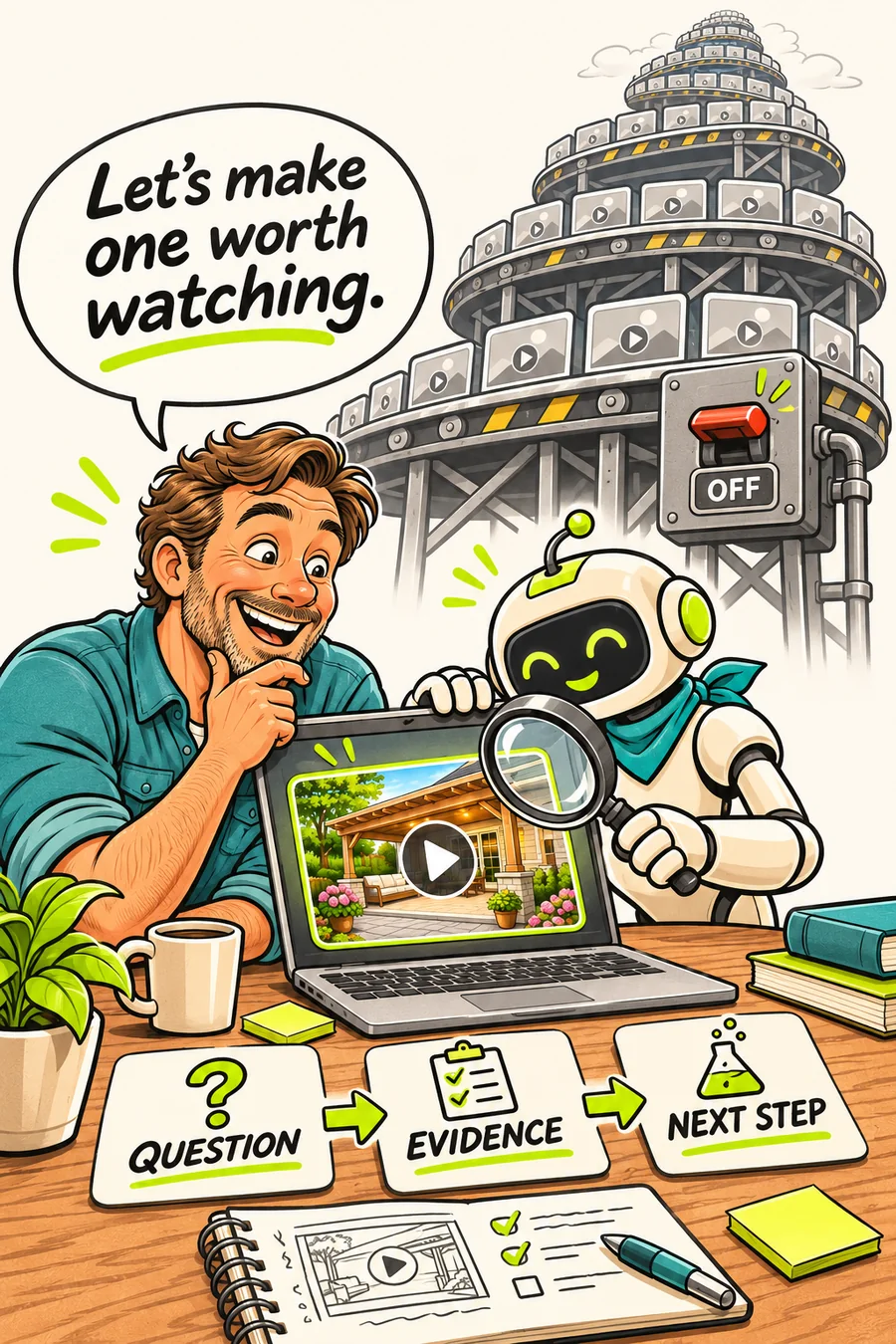
AI can make it easier to develop scripts, explore different explanations, and produce or revise content.
That creates an opportunity to test ideas without treating every video as a major production. But easier production also makes it easier to produce large quantities of forgettable material.
AI can help us make more videos. That is only useful if we have something worth saying and a sensible plan for who needs to hear it.
The questions remain the same: Is the content accurate? Is it relevant? Is it convincing? Does it reflect your business? Does it help a prospective customer move forward?
How many videos would you need?
We would rather identify a small set of useful subjects than invent a large publishing quota.
A starting point might be your most important customer question, your most common objection, and one strong example of your work.
That is an illustration, not a universal formula. Some businesses need a different approach. Some may get more immediate value from improving an existing page, strengthening their evidence, or fixing the inquiry process first.
The amount of content should follow the job it needs to do.
What we can promise—and what we can’t.
We cannot honestly promise that a particular number of videos will produce a particular number of customers.
We can explain:
- Who the content is intended to help.
- What question or objection it addresses.
- What makes the answer credible.
- Where it will be used.
- What action it should support.
- How we will assess whether the approach deserves more investment.
That is the difference you should ask any provider to explain.
You don’t need another speech about the power of video.
You need a credible answer to:
“What will you do differently from what I already tried?”
If the answer is simply “make more videos,” your skepticism is justified.
If the answer connects your customers’ questions, your expertise, a distribution plan, and a measurable business purpose, there may be something worth testing.
Tried video and been disappointed?
Tell us what you tried, where you used it, and what you hoped would happen. Share links to the videos if you still have them.
We can discuss what might be worth changing—and whether video is the right next priority for your business.
Get help making your content work harder